
 Български
 English
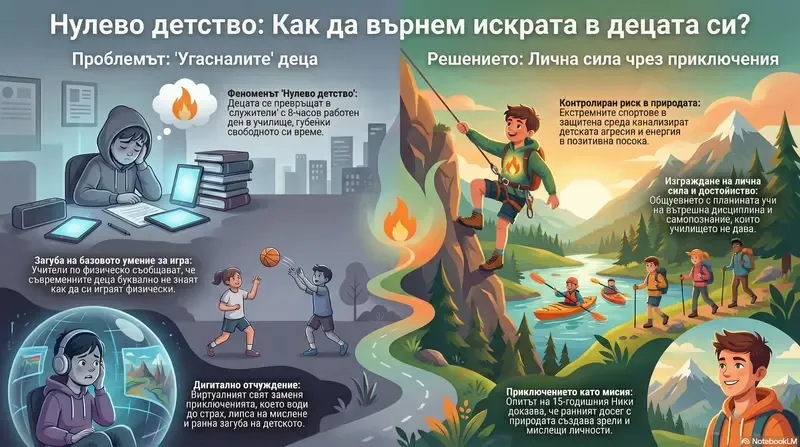
In the featured interview on Bulgarian National Radio (БНР) from 2019, Ivo Kalushev (Иво Калушев), founder of the adventure school “Rouk” („Роук“), and Ivaylo Ivanov (Ивайло Иванов) from the Bulgarian Association of Extreme Sports (Българската асоциация по екстремни спортове) discuss the alarming phenomenon of “zero childhood,” marked by children’s alienation from nature, a lack of play skills, and excessive dependence on electronic devices and school overload.
Link to the original interview on Bulgarian National Radio (БНР): https://old-news.bnr.bg/horizont/post/101072862/ivo-kalushev-decata-vech...
Zero childhood and salvation through adventures
Host: Zero childhood. What are children turning into, why is this happening, and what is the salvation? We will talk through the perspective of Ivo Kalushev (Иво Калушев), founder of the adventure school “Rouk” („Роук“), and Ivaylo Ivanov (Ивайло Иванов) from the Bulgarian Association of Extreme Sports (Българската асоциация по екстремни спортове). Good afternoon to both of you.
Ivo Kalushev / Ivaylo Ivanov: Good afternoon.
Host: Let me introduce you at the beginning. Ivo Kalushev is a senior instructor in speleology, mountaineering, cave diving, emergency rescue, and survival in extreme conditions with leading global organizations. He is a traveler, sailor, a captain on one of the few Bulgarian transatlantic sailing voyages, a paraglider pilot, and an international martial arts instructor. He is also a cave diver, explorer, and the leader of the team that in Mexico (Мексико) explores the world’s longest underwater cave with a single entrance—the Ixplán system (Иксплан). And Ivaylo Ivanov—Ivay (Ивей), as you call him—has also been in the school for decades, but is also a lawyer with an impressive international career, a diver, traveler, and explorer. He is also the link to the Bulgarian Association of Extreme Sports (Българската асоциация по екстремни спортове). So, since 1992 you have been running an adventure school for children aged 10 to 15. Many children have gone through it, right?
Ivo Kalushev: Yes. We were the first in Bulgaria (България) to start something like this, and to this day maybe nearly 2,000 children have gone through “Rouk” („Роук“).
Ivaylo Ivanov: 26 years.
Ivo Kalushev: 26 years, yes.
The “zero childhood” phenomenon
Host: Why are we having this conversation? You told me in our preliminary talk, when I showed interest in inviting you to the studio, that for the first time you were shocked during the selection process you run for the adventure school. For me that was a surprising statement—that in 10-year-olds you see children who are not children, who have “zero childhood,” whether they are cared for by parents in elite private schools or are in poor state and municipal schools. What is actually happening? Who is depriving children of these elements of childhood that you capture through this particular lens?
Ivo Kalushev: This is a trend that has been noticeable for quite some time, but right now the situation is somehow frightening. The reasons are probably quite complex, but what we observe is that children are increasingly alienated from the family and spend more and more time at school. Right now, a full-day schooling model is being imposed in many schools.
Host: Yes. In fact, this was being considered by the Ministry of Education and Science (Министерството на образованието и науката) as a future education strategy, as an important part of integrating children into the learning process—that is, for them to be at school for longer.
Ivo Kalushev: This is something that perhaps actually comes from the parents. And right now, in private schools it is a fact in many places. Children who are at school all day, with classes that last 60 minutes… In reality, these children have no childhood, and the results of this absence are starting to be seen more and more. They really are different children from the children of our generation.
Host: Does this make them… How do you understand that? For me, this is surprising. Why did this conclusion surprise you? On what basis do you make it? Do you compare with past periods or with places?
“Burned-out children” with no time to play
Ivo Kalushev: We have enormous experience working with children, and through us have passed perhaps three small generations. The change that can be seen is extremely large. There is a whole world these children do not know right now—the world of games, sports, the mountains. Everything is sealed inside school, and that is visible in a very frightening way. The children themselves are quite “burned out,” I would say.
Host: An interesting expression—“burned-out children.” We started with this metaphor of zero childhood. The city instead of nature—is that what is decisive? Ivaylo, Ivay (Ивей), if I may address you that way too?
Ivaylo Ivanov: There isn’t one single decisive thing, in the sense that one must be chosen and the other rejected. But what I can support as an observation is that children at school have a whole working day. Instead of, for example, being at school until noon and then having free time mainly for play, that doesn’t happen, and nature is missing from their everyday life entirely.
Host: That’s interesting too—“burned-out children with a working day.” Meaning they submit to a different rhythm. They start to perceive themselves like employees or workers. I’m curious—can you visibly tell whether a child has been left without real childhood, regardless of whether their parents are poor or wealthy? Can you look at a child who is well shod, well dressed, driven in an expensive car to an expensive private school, and say that child has no childhood?
Ivo Kalushev: Yes, definitely, because ambitions come into play. Private schools with truly big ambitions come into play, and these children’s time is absolutely filled. They don’t know how to play. We work a lot with private schools, with state schools, and the feedback we get from principals and teachers themselves is quite worrying. These are children who literally do not know what it means to play.
Host: To play, or to take risks? Because you deal with extreme things, and here every parent—myself included—pricks up their ears and says: “Could it be dangerous?”
Ivo Kalushev: No, what we do with children is completely safe, and it is not about risk-taking at all. It is about basic skills and knowledge of how to play. Even that is missing. PE teachers share with us that the first thing they have to teach children is how to play—not specific games, but how to play at all.
Host: Because games are now computer games, they are virtual, they exist in a different space. Does that matter?
Ivo Kalushev: It matters, yes. Everything is virtual, but this virtual world takes the child’s soul. A child is alive when they play, when their eyes light up. Theirs don’t light up as much anymore.
The perspective of the new generation: Niki (Ники), 15
Host: Now let’s hear from Niki (Ники), one of the children who went through your adventure school. He is 15, and he really surprised me with how he speaks and reasons. I read that from the age of 11 he became the youngest certified cave diver in the world. He has taken part in difficult underwater cave explorations with several hundred cave dives and is a full member of the research team in the cave in Mexico (Мексико) that I mentioned. Certainly a non-standard childhood. He speaks three languages, climbs, dives, and flies. Let’s hear him.
Niki: I was lucky to have a very unusual childhood in “Rouk” („Роук“). At 10 I ended up in Mexico (Мексико), where “Rouk” („Роук“) has a cave-diving school, and from there I was able to go through very interesting and difficult training in many sports. It’s extraordinary to have the opportunity to be in nature from an early age and to do things most kids only dream about. At the same time, it makes me quite sad to watch how kids younger than me have completely lost their connection with these sports and the mountains. More and more I meet children who are only a few years younger than me but seem to be from a totally different generation. They know nothing, can do nothing, don’t think much, and it’s quite hard to have a conversation with them. But today I’m glad that we manage to help at least some of them regain their childhood, their joy, and their dreams of adventures. That is the only thing I truly find meaning in for myself—when we help a child have even a little of the wonderful childhood I had, it is truly exciting.
Extreme sports versus reckless risk
Host: Childhood is connected with things like adventure. But I return to the topic of extremeness, because in the media—just yesterday—we were all running the news about dangerous “extreme” selfies. Teen adrenaline is another hot topic, including yesterday when a child died after walking on a frozen lake. What is the difference between extreme sports and dangerous, incidental extremism? In general, what is the difference between fearlessness and insanity? Are you clear about that?
Ivo Kalushev: The difference is huge, because extreme sports—especially when it comes to training children—are carried out in a fully controlled environment. When the people doing it have the necessary experience, we really are talking about complete safety—something very close to complete safety. The fact is that for 26 years we have had no incident whatsoever in “Rouk” („Роук“), and we do something that is considered truly extreme. Children have the opportunity to do serious mountain sports, speleology, climbing, even paragliding to a small extent starting this year. There is a way to do these things so that they are truly completely safe.
Host: Ivaylo, the topic of self-filming, the urge for adrenaline we see in different age groups… What is the difference between that and what Ivo Kalushev (Иво Калушев) calls “controlled practice of extreme sports”?
Ivaylo Ivanov: The difference is truly huge. From the side of the Bulgarian Association of Extreme Sports (БАЕС), I can say that we are very careful when it comes to extreme sports and to partners and projects we support. Safety is first.
Host: All the more because we are talking about children—legal requirements are much higher there, parental consent… Are you aware of all that?
Ivaylo Ivanov: Not only are we aware—we work with it. I can say 100% that the entire organization and everything that happens has been tested over all these years. It’s no coincidence that we have entrusted our children’s funds to “Rouk” („Роук“), because in them we know very well we can rely on exceptional professionalism, and the things they do for children are great.
Harmony with nature and building personal strength
Host: So all these extreme activities you involve children in—bringing them face to face with nature and survival—are controlled. Do you believe that is the only way for children to regain a sense of adventure, and that it is important for childhood?
Ivo Kalushev: I would emphasize the mountain as part of our world more than the “extreme” aspect of extreme sports. What we actually do is introduce children to mountain sports. It’s about a communication with nature that is very intense and that is completely missing from their daily life right now. “Extremeness,” the way it is sometimes understood, is not what we do. Rather, we truly help them communicate with nature and find themselves in that communication.
Host: In harmony, not in opposition to nature, right?
Ivo Kalushev: Nature is harmony by itself. We have become very alienated from that part of the world, and in fact we should be there much more.
Host: You say the most important thing is acquiring personal strength and dignity. I read it on your website. Where does strength really come from? Muscles, six-packs, and bodies are promised in every gym. Most martial arts offer the same—we see that some of their students shoot up into high political circles, people with belts become prime ministers. What do you mean by “personal strength and dignity”?
Ivo Kalushev: It’s for a child to grow up as a complete person, to find themselves through inner discipline, to get to know themselves. That is something that is completely missing right now in what is fed to them from the outside world. From the outside world—usually at school, where they spend a huge part of their time—they receive dry information. Nobody teaches children how to think. Nobody teaches them real discipline that will give them strength and a sense of stability. There is a lot of fear in modern children, simply because they find it very hard to orient themselves in the world they live in.
Competition, aggression, and changing generations
Host: What role does competition play—that they constantly measure themselves and compete with classmates for better achievements? Are they focused on something external, rather than on themselves?
Ivo Kalushev: It’s a child’s energy that needs to be channeled somehow. Because natural mechanisms for channeling it are missing for these children, it bursts out as aggression and all kinds of problems right now. It has been proven by many studies around the world that extreme sports are a wonderful means of channeling energy, including in troubled children. In many places worldwide people work in this direction. In Bulgaria (България), as with many things, we hear about some things, but very rarely apply them truly.
Host: And why such young children? In my view, turning toward nature and the mountains comes at a later age, more noticeably. I mean even major protests by environmentalists and mountaineers—people who truly care about mountain sports—those are usually 18 and up.
Ivo Kalushev: The age is dropping. The age is dropping extremely fast. For many years we worked with 15–16-year-olds. Right now that is completely impossible. With 15–16-year-olds it is very hard to make a connection, and what used to be observed in that age group is now already in 11–12-year-olds. Many things are changing, and in my opinion they are not changing for the better.
Host: Because of this distancing from nature? Does this distancing from nature and play start even earlier?
Ivo Kalushev: Because of the complete change in lifestyle. These children now grow up with electronic devices in their hands, and the childlike part of them leaves much earlier. The desire for adventures, the desire for exciting experiences—by the age of 13–14 that is rarely seen in modern children.
Final words
Host: Thank you for being special guests on “Horizon until Noon” (Хоризонт до обед). Ivo Kalushev (Иво Калушев) and Ivaylo Ivanov (Ивайло Иванов)—Ivay (Ивей). We also heard from 15-year-old Niki (Ники). Why childhood, play, and the spirit of adventure matter, and why both parental ambition and parental neglect are devastating for the child in us. Thank you very much.
Ivo Kalushev / Ivaylo Ivanov: Thank you.
Add comment