
 Български
 English
Bulgaria's participation in World War I was marked by unprecedented tactical successes on two fronts, which later led to a total economic collapse and a deep national crisis.
Entering the war and the Macedonian Front
Bulgaria initially declared neutrality because it recognized its own weakness and lack of heavy industry. The situation changed dramatically when the Ottoman Empire joined the Central Powers, turning Bulgarian territory into a key geographical asset for the outcome of the conflict. Attracted by German promises to return lost Macedonia and provide full military equipment, the country entered the war in September 1915.
The Bulgarian army quickly defeated Serbian forces, but the German high command deliberately prohibited their pursuit into Greek territory in order to create an entirely new front and pin down hundreds of thousands of enemy soldiers. As a result, the Macedonian Front was formed, where the army built an impressive defensive system of trenches and concrete shelters across extremely difficult mountainous terrain. For nearly three years, Bulgarian forces successfully repelled large-scale attacks by a massive international coalition, inflicting enormous casualties upon it.
War on two fronts and tactical innovations
In the summer of 1916, Romania joined the Entente, forcing Bulgaria to fight on two fronts simultaneously. Bulgarian troops invaded Romanian territory and captured the key fortress of Tutrakan only five days after a fierce assault. They captured nearly 30,000 enemy soldiers, dealing a severe blow to the opponent's morale and forcing it to divert additional forces from other directions.
General Ivan Kolev carried out a true revolution in military tactics by creating a rapidly moving strike force of dismounted cavalry. He integrated machine-gun companies and mobile artillery directly into cavalry regiments, creating an early and highly successful version of blitzkrieg on horseback.
| Indicator | Bulgarian army under General Kolev's command | Entente forces (Romania, Russia, Serbia) |
|---|---|---|
| Numbers | Forces half the size | Twofold superiority |
| Tactics | Aggressive cavalry attacks on the flanks and rear | Traditional frontal defense |
| Final result | Decisive victory, awarded the "Iron Cross" by the Germans | Retreat and disproportionately heavy losses |
In the Battle of Dobrich, Kolev defeated an enemy twice his size, earning the admiration of the German high command and receiving the prestigious "Iron Cross" order. Thanks to his actions, the Central Powers quickly occupied southern Romania and gained full access to its enormous grain and oil resources.
Economic catastrophe and famine
Despite the brilliant victories along the borders, the interior of the country sank into one of the most severe crises in its history. The state mobilized around 1.2 million men, representing practically the entire male population of military age and the highest mobilization percentage among all participants in the conflict. Agriculture was left entirely in the hands of women, children, and elderly people, inevitably leading to a catastrophic decline in grain production.
Inflation increased the cost of living eightfold, while corrupt officials smuggled food to Germany's allies under the guise of military supplies. The government confiscated essential food products to send them to the front, condemning the civilian population to hunger and widespread malnutrition.
Main factors behind the internal collapse:
- Unprecedented mobilization: Sending almost half of the male population to the front left agriculture without any available workforce.
- Economic exploitation: German soldiers purchased Bulgarian food supplies using their higher wages, creating a massive black market.
- Logistical collapse: Germany halted deliveries of vital military equipment, leaving the Bulgarian army barefoot and in actual rags.
Collapse of the front and capitulation
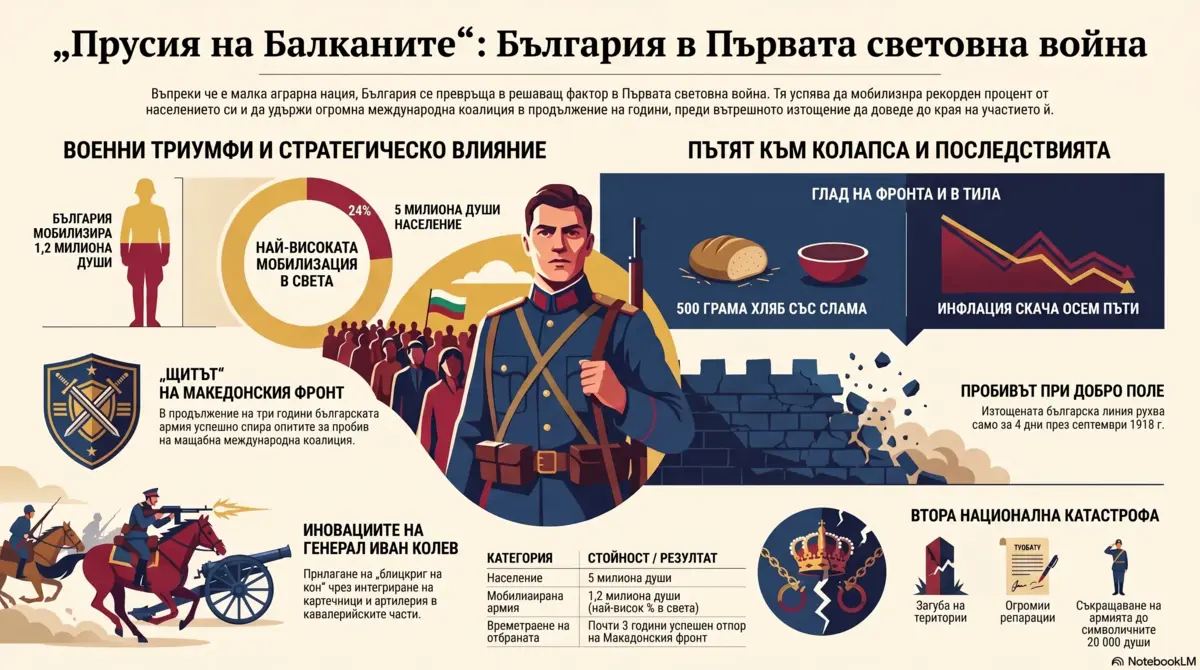
By the summer of 1918, the Bulgarian army was completely exhausted, and soldiers survived on symbolic rations of bread mixed with straw or ground corn cobs. The German command withdrew its divisions and artillery from Macedonia because of a planned offensive on the Western Front, leaving Bulgarian lines critically weakened.
In September, 700,000 well-equipped Entente soldiers launched a large-scale attack at Dobro Pole, where they had a fourfold superiority in artillery. The Bulgarian line collapsed within four days, and thousands of deserters headed toward the capital in an attempt to punish the leaders who had brought them into this disastrous war.
On September 29, Bulgaria signed an armistice and capitulated, triggering a domino effect that led to the rapid collapse of the entire alliance of the Central Powers. After the war, the country lost all conquered territories, was burdened with unbearable reparations, and its army was reduced to a symbolic 20,000 soldiers, causing deep national disappointment and a sense of humiliation.
Add comment